
What Are the Top Types of Paperback Notebooks?
Table of Contents
- How Paperback Notebooks Are Classified by Page Layout
- Ruled Paperback Notebooks for Writing and Note-Taking
- Blank Paperback Notebooks for Sketching and Freeform Work
- Grid and Dot-Grid Paperback Notebooks for Structured Pages
- Specialized Paperback Notebooks for Planning and Focused Tasks
- FAQS
- Conclusion
- Related Posts
Paperback Notebooks remain practical tools for study, planning, sketching, and everyday notes. Their formats shape how people use them: composition books suit classroom work, subject notebooks separate courses, and pocket notebooks fit brief notes on the move. Ruled pages support writing; dotted or blank pages leave more room for diagrams and sketches. Small design choices matter.
Market figures offer context, but not a direct ranking of notebook types. Grand View Research’s Stationery Products Market report estimated the global stationery products market at USD 145.2 billion in 2022, with projected growth through 2030. That broad category includes many products beyond notebooks, so the figure should not be read as notebook-only demand. It does, however, show the scale of the wider market in which paper notebooks compete with digital tools and other stationery.
There is no single best format. A student carrying several textbooks may prefer a sturdy composition notebook; a traveler may reach for a slim pocket edition. Productivity consultant David Allen’s well-known advice, “Your mind is for having ideas, not holding them,” captures one reason people keep paper nearby. It is a useful perspective, not a notebook-industry market finding. And paper has limits: pages fill, and bulky notebooks can be a nuisance. This guide compares the top types of Paperback Notebooks by format, page layout, portability, and likely use, so readers can choose with clearer expectations.
How Paperback Notebooks Are Classified by Page Layout
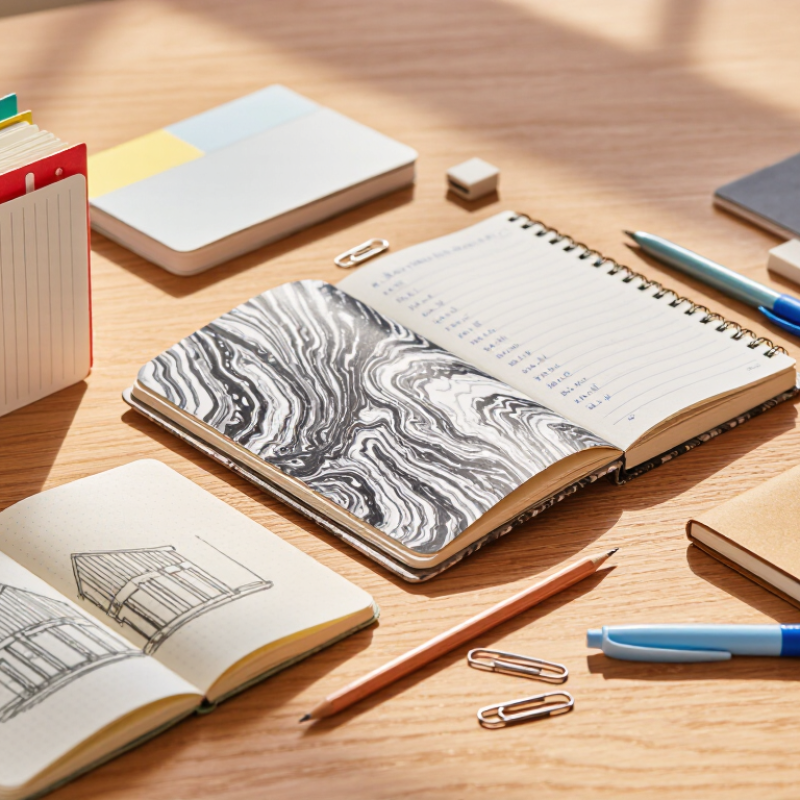
Paperback notebooks are often classified by how their pages are printed, since layout affects writing, sketching, and organizing notes. The cover may be soft, but the page pattern determines how the notebook feels in daily use.
Ruled pages suit class notes, journal entries, and lists. Wide ruling leaves more room for larger handwriting, while narrower lines fit more words on each page. Blank pages offer freedom for sketches, diagrams, or handwriting that does not follow straight lines. They can feel less structured, though, especially when you need to keep long notes tidy.
Dot-grid pages use small, evenly spaced dots as subtle guides for writing, tables, or simple drawings. Graph pages have continuous squares, which help with measurements and charts but can make a page feel busy. Small detail, big difference. Before choosing, look at a sample spread and try writing a few lines. Check whether the spacing fits your handwriting and whether the printed guides show through from the reverse side. That last point is easy to miss. A layout that looks neat on an empty page may feel cramped once your notes and sketches share the space.
Ruled Paperback Notebooks for Writing and Note-Taking
Ruled paperback notebooks suit writing and note-taking because their printed lines give each sentence a steady baseline. A narrow ruling fits compact handwriting and longer class notes; wider spacing leaves room for larger letters and quick annotations. Paperback covers bend easily in a bag, though they may crease at the corners. That trade-off is real.
Their usefulness is supported by research on handwritten notes. In three experiments published in Psychological Science, Mueller and Oppenheimer found that students taking longhand notes answered conceptual questions better than laptop note-takers. They also cautioned that handwriting encourages students to summarize rather than transcribe verbatim. A ruled page can help organize those summaries: dates in the margin, short headings, and a few lines left open for later questions. The rule is not magic. Crowded writing still becomes hard to review.
For practical selection, check paper opacity, binding strength, and page count, not just cover appearance. A 2023 report from the National Literacy Trust surveyed more than 76,000 children and found that writing enjoyment was associated with stronger writing engagement; it does not prove that notebooks cause better skills. Still, a portable, comfortable notebook may make regular practice easier. Test a page with your usual pen before committing: ink show-through can distract, and very pale ruling may disappear under warm desk lighting. A little imperfect spacing is fine. Legibility matters more.
Blank Paperback Notebooks for Sketching and Freeform Work
Blank paperback notebooks give sketches room to shift into notes, diagrams, or half-formed ideas. With no ruling to follow, a pencil can travel across the page without hitting a grid. A soft cover bends easily in a tote, though it may crease beside a metal water bottle. Choose paper that accepts your usual tools: thin sheets can show ink through, while heavily textured stock may snag a fine pen. Check the paper weight and test a page if you can. Small details matter.
Two Sides’ 2023 Trend Tracker surveyed 10,250 consumers in 16 countries; 65% preferred printed books to e-books. That finding concerns reading, not sketching, so it should not be treated as proof that paper improves drawing. Still, it offers context for paper’s continued appeal. A 2014 peer-reviewed study by Mueller and Oppenheimer included 65 students and found that handwritten note-takers performed better on conceptual questions than laptop note-takers. Sketching is different, of course. Yet a blank page can make it easier to connect an image with a quick written observation. The trade-off is real: an open spread feels freeing, then sometimes directionless. A faint pencil guide can help, but it may also constrain the work.
Grid and Dot-Grid Paperback Notebooks for Structured Pages
Grid and dot-grid paperback notebooks offer structure without forcing every page into a fixed format. A grid’s faint squares help align headings, tables, diagrams, and quick sketches. Small squares matter. They make spacing easier to judge, especially when tracking habits or mapping a project. Dot-grid pages use lighter visual cues. The dots guide writing and drawing but leave more open space for free-form notes.
For everyday planning, use grid pages for weekly layouts, measurements, or lists that need tidy columns. Dot grids suit mixed pages: a short task list beside a rough room sketch, for example. A ruler can help with clean dividers, though many people find the dots sufficient. Try one page before settling on a layout. Your handwriting may look cramped in a small grid, while widely spaced dots can make short notes feel scattered.
Paperback covers are light and easy to carry, but they may bend inside a crowded bag. Check whether the notebook opens comfortably and whether its paper works with your usual pen. A quick test on a back page can reveal show-through or smudging. Some ink may bleed through, so avoid assuming every page supports markers. I still find that neat templates can become a little rigid; leaving a blank corner often makes a notebook more useful.
Specialized Paperback Notebooks for Planning and Focused Tasks
Specialized paperback notebooks turn broad intentions into visible actions. A weekly planner can reserve one box for appointments, another for three priority tasks, and a slim margin for changes. A project notebook benefits from dated pages, checkboxes, and a few blank lines for unexpected details. Keep the layout easy to scan. Small format matters. If every task gets equal space, urgent work can disappear among routine notes.
For focused work, use a dedicated notebook for one activity, such as study notes, meeting actions, or daily time blocks. In a 2014 Psychological Science study, Mueller and Oppenheimer reported two experiments involving 65 and 151 participants. Longhand note-takers performed better on conceptual questions than laptop note-takers, though the research did not test notebook formats directly. That distinction matters. Paper may support active selection, but no layout guarantees concentration. A planner can still become cluttered, especially when tasks are copied forward without review. Leave room to revise the system; a scratched-out box is useful evidence, not a failure.
What Are the Top Types of Paperback Notebooks?
Notebook size can shape how easily you plan, take notes, or focus on a task. This chart compares standard paper dimensions commonly used in paperback notebooks.
A6 is compact for quick lists and portable planning; A5 is a versatile everyday size; B5 and US Letter offer more room for detailed notes and structured task plans. Dimensions are standard sheet sizes, converted to inches and rounded to two decimal places.
FAQS
Ruled, blank, dot-grid, and graph pages support different tasks. The layout changes how writing, sketches, and notes fit together.
Ruled pages suit class notes, journal entries, and lists. Wide lines give larger handwriting more room; narrow lines fit more words.
Yes. Blank pages leave room for diagrams and free-form writing. Long notes can be harder to keep tidy, though.
Grid pages have continuous squares for charts and measurements. Dot grids offer lighter guides for writing and simple drawings. Small detail, big difference.
Try writing a few lines on a sample spread. Check the spacing and whether guides show through from the reverse side. Easy to miss.
They can. Small squares may crowd handwriting, while widely spaced dots can make short notes feel scattered. Leave a blank corner if needed.
See whether it opens comfortably and works with your usual pen. Test ink on a back page for smudging or show-through. Covers may bend in a crowded bag.
Give appointments, priority tasks, and changes separate spaces. Keep the page easy to scan. Too many equal-sized boxes can hide urgent work.
No layout guarantees concentration. One study found longhand note-takers did better on conceptual questions, but it did not test notebook formats directly.
Review tasks instead of copying them forward without thought. A scratched-out box can show what needs changing. The system may still feel imperfect.
Conclusion
Paperback Notebooks come in several types, most commonly distinguished by the layout of their pages and the tasks they support. Ruled notebooks feature horizontal lines that help keep handwriting organized, making them useful for class notes, journaling, lists, and everyday writing. Blank notebooks have no printed guides, giving users open space for sketches, diagrams, brainstorming, or other freeform work.
Grid and dot-grid Paperback Notebooks offer structure without limiting how a page can be used. Grids can help with charts, calculations, and precise drawings, while dot grids provide subtle alignment for notes, layouts, and creative projects. Specialized notebooks are designed around focused activities such as planning schedules, tracking habits, setting goals, or organizing particular projects. Choosing a type depends on whether the priority is neat writing, creative freedom, visual structure, or a dedicated system for staying organized.

Blog Tags: