
2026 Best Jigsaw Greeting Cards for Global Buyers
Table of Contents
- Global Jigsaw Greeting Card Market: Statista Trends and 2026 Demand Data
- Card Formats and Piece Counts: 300–1,000-Piece Buyer Specifications
- Material and Print Standards: FSC Paper, GSM, CMYK, and ISO 216 Sizes
- Safety and Export Compliance: ASTM F963-23, EN 71, and CPSIA Requirements
- Supplier Evaluation: MOQ, Lead Time, Defect Rates, and Global Pricing Metrics
- FAQS
- Conclusion
- Related Posts
Choosing the 2026 Best Jigsaw Greeting Cards requires more than comparing colorful artwork and cheerful messages. Global buyers need products that combine emotional value, practical quality, and dependable delivery. Jigsaw Greeting Cards should feel like a small experience, not merely a folded piece of paper.
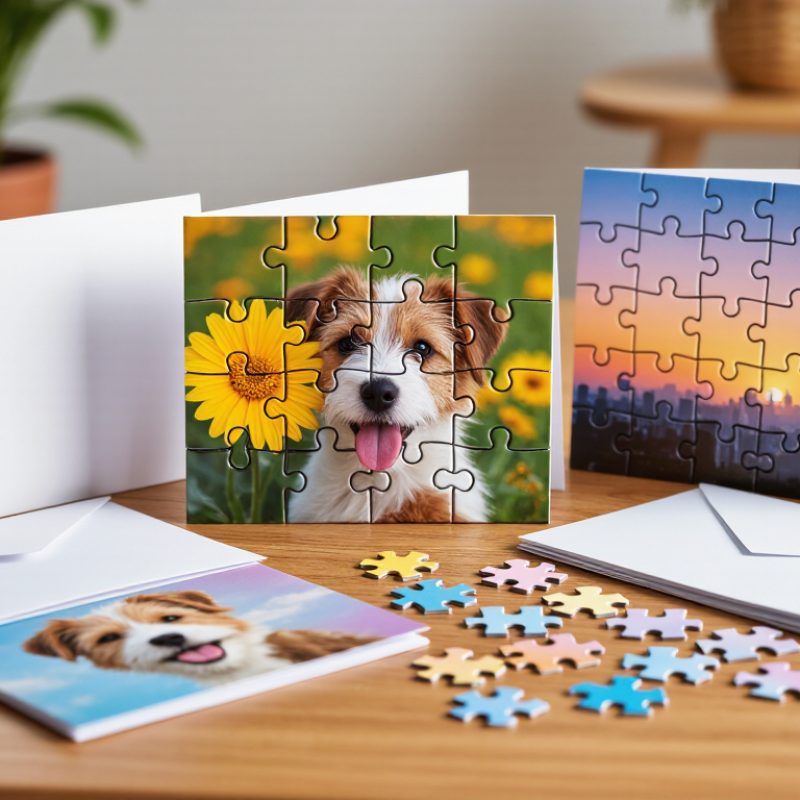
Will Shortz, a respected puzzle editor and creator, once said, “A puzzle is a problem that has been made fun.” His observation explains why these cards continue attracting families, collectors, and thoughtful gift buyers. A well-designed card reveals an image gradually, turning a birthday wish or holiday message into shared participation. The first pieces might show a bright flower, a familiar skyline, or a smiling pet. Small details create curiosity.
Material selection deserves close attention. Buyers should examine cardstock thickness, print clarity, puzzle-piece precision, envelope strength, and packaging protection. Sustainable paper can improve brand appeal, but environmental claims still require evidence. A beautiful design cannot repair weak cutting or damaged corners. Not every popular card performs equally well.
This guide evaluates leading Jigsaw Greeting Cards for international purchasing decisions. It considers design originality, assembly experience, message space, packaging, customization, and suitability for different markets. Cultural preferences also matter. A snowman may sell strongly in one region and feel irrelevant in another. Language accuracy matters too.
There is no perfect card.
Some designs may look impressive online but feel disappointing in hand. Others may appear simple yet create memorable moments around a kitchen table. Careful buyers should request samples, inspect print quality, and test the completed puzzle before placing larger orders. Reliable choices come from evidence, not attractive product photos alone.
Global Jigsaw Greeting Card Market: Statista Trends and 2026 Demand Data
Statista trend data suggests steady interest in personalized paper products through 2026. Jigsaw greeting cards fit this shift well. They combine a message, a small activity, and a keepsake in one compact format. Demand may grow among gift buyers seeking more interactive experiences. However, market figures should be checked against local sales data before large orders.
Global buyers should assess piece quality, print accuracy, and postal durability. A useful card opens cleanly and assembles without confusing edges. Thick, responsibly sourced paper can reduce bending during international delivery. Clear instructions matter, especially for older recipients or first-time users. Buyers should also request samples before confirming seasonal quantities.
The best designs may use local scenes, celebrations, or gentle humor. Cultural testing is still essential. A popular image in one region may feel ordinary elsewhere. Packaging should protect the puzzle without creating excessive waste. Small trial shipments can reveal real customer reactions, customs delays, and damaged corners. The data offers direction, not certainty. That limitation deserves attention.
Card Formats and Piece Counts: 300–1,000-Piece Buyer Specifications
2026 Best Jigsaw Greeting Cards for Global Buyers
Card Formats and Piece Counts: 300–1,000-Piece Buyer Specifications
Jigsaw greeting cards now combine a keepsake image with a shared activity. Grand View Research estimates the global jigsaw puzzle market will expand steadily through 2030, with rising demand for educational and recreational products. For global buyers, piece count remains a practical specification, not a decoration. A 300-piece card suits families, casual gifting, and smaller tables. A 500-piece format offers stronger engagement without excessive assembly time. The 750–1,000-piece range targets experienced puzzlers and premium seasonal gifts.
Card dimensions also affect shipping, handling, and final use. A folded card can hold a compact puzzle insert and message panel. A flat panoramic format supports scenic artwork but needs stronger packaging. For export orders, buyers should confirm finished size, piece tolerance, board thickness, print clarity, and packing protection. A 500-piece puzzle with thin board may feel less valuable than a well-cut 300-piece version. This is easy to underestimate.
Tips: Match the count to the recipient, not only the artwork. Confirm sample assembly before approving volume production. Circana’s 2024 U.S. toy industry reporting showed games and puzzles remained a resilient category, but category performance varies by market. That difference matters. A 1,000-piece card may impress one buyer and discourage another. We still see specifications treated as universal, which is not always realistic. Context should guide the final choice.
2026 Best Jigsaw Greeting Cards for Global Buyers
Card Formats and Piece Counts: 300–1,000-Piece Buyer Specifications
This reference compares commonly used retail jigsaw formats by piece count and approximate finished puzzle area. Larger piece counts generally require more assembly time and stronger packaging protection. Finished dimensions are representative specifications and may vary by manufacturer, piece shape, and artwork layout.
Material and Print Standards: FSC Paper, GSM, CMYK, and ISO 216 Sizes
For global buyers, material choices shape both the puzzle experience and the greeting card’s credibility. FSC-certified paper supports responsible sourcing, but buyers should request current documentation rather than trust a printed claim alone. A 300 GSM cover feels firm in the hand and resists bending during packing. A lighter 250 GSM sheet may fold more easily, yet it can feel less premium. Details matter. Ask for a physical sample before approving full production.
Print accuracy also depends on process control. CMYK artwork should include a calibrated proof, especially for deep reds, skin tones, and small text. Screen colors can look brighter than the final ink. ISO 216 sizes make international ordering clearer: A6 measures 105 × 148 mm, while A5 measures 148 × 210 mm. Confirm whether measurements describe the folded card, the open card, or the puzzle area. This small difference can affect envelopes, displays, and shipping cartons. Measure twice. In production reviews, I have found that even careful specifications leave room for error. A few pieces may show slight color variation or edge softness. Buyers should define acceptable tolerances, inspect samples under neutral light, and record results before shipment. That practical step protects quality without promising unrealistic perfection.
Safety and Export Compliance: ASTM F963-23, EN 71, and CPSIA Requirements
For global buyers, a jigsaw greeting card is not only paper merchandise. If children can assemble, play with, or handle it, authorities may treat it as a toy. This classification affects testing, labeling, and technical files. The U.S. Consumer Product Safety Commission reported an estimated 231,700 toy-related emergency-department injuries among children under 15 in 2023. Small pieces and sharp edges remain practical concerns.
ASTM F963-23 is the current U.S. toy safety standard, covering materials, mechanical hazards, flammability, sound, and chemical limits. Under CPSIA, children’s products generally require testing by an accepted third-party laboratory and a Children’s Product Certificate. Lead, phthalates, accessible magnets, and tracking labels need careful review. A card with a metal clip or surface coating can change the testing plan. Do not assume paper means low risk.
For European sales, EN 71 usually includes mechanical and physical properties, flammability, and migration of certain elements. Chemical restrictions may also connect with REACH requirements. The EU Safety Gate 2023 report recorded 3,412 product alerts, showing why documentation cannot be treated as paperwork only. Export files should match the actual artwork, puzzle count, ink, coating, packaging, and age grading. An honest weakness is that suppliers sometimes test a similar sample instead of the final product. That shortcut can create costly gaps. Keep batch records, laboratory reports, declarations, and warning translations together before shipment.
Supplier Evaluation: MOQ, Lead Time, Defect Rates, and Global Pricing Metrics
For global buyers, supplier evaluation should begin with measurable limits, not attractive samples.
Set a trial MOQ of 500–1,000 sets when possible. Ask for a separate price at 1,000, 3,000, and 10,000 units. This reveals scale savings and prevents misleading quotations. Track unit cost, tooling, packaging, inspection, freight, duty estimates, and payment terms. A low factory price can become expensive after delivery.
Lead time needs a calendar definition.
Confirm artwork approval, pre-production sampling, manufacturing, inspection, and dispatch separately. UNCTAD’s Review of Maritime Transport 2024 states that ships carry over 80% of world trade by volume. Port congestion can therefore change delivery promises quickly. Add a buffer for ocean freight.
The World Bank’s 2023 Logistics Performance Index evaluates customs, tracking, infrastructure, and timeliness. Request lane-specific delivery records, not only country rankings.
Defect control should cover color registration, paper cutting, puzzle-piece fit, glue marks, corner crushing, and barcode readability.
Use ISO 2859-1 sampling tables and agree on an AQL level before production. For premium greeting cards, an internal target below 1% major defects is practical, though it is not a universal industry rule. Require dated inspection photos and carton-drop evidence.
QIMA’s quality-inspection reporting repeatedly highlights the value of early checks before shipment. One weakness remains: suppliers may report averages without showing failed batches. Ask for both. Mistakes often hide there.
FAQS
They combine a personal message, a short activity, and a keepsake. Some buyers prefer interactive gifts over ordinary paper cards. Market forecasts offer direction, not certainty.
Request physical samples first. Check clean opening, accurate printing, firm pieces, and clear instructions. Test postal handling, especially at corners.
Thick, responsibly sourced paper can reduce bending. Protective packaging should prevent crushed corners and loose pieces. Avoid unnecessary layers that increase waste.
It may be treated as a toy when children can handle or assemble it. Small pieces and sharp edges need careful review. Paper does not automatically mean low risk.
Buyers may need laboratory testing, age grading, warning labels, and a children’s product certificate. Review chemical limits, accessible magnets, coatings, and metal clips. Keep reports with the final artwork and packaging details.
A trial order of 500 to 1,000 sets can limit early risk. Request prices at 1,000, 3,000, and 10,000 units. Include packaging, inspection, freight, duties, and payment terms.
Separate artwork approval, sampling, manufacturing, inspection, and dispatch dates. Add an ocean-freight buffer for port delays. A promised date without a calendar plan is weak.
Inspect color registration, cutting, piece fit, glue marks, crushed corners, and barcode readability. Agree on a sampling method and acceptable defect level before production. Request dated photos and carton-drop evidence.
Yes, local scenes, celebrations, and gentle humor may perform better. Test cultural reactions before mass production. A popular image in one market may feel ordinary elsewhere.
Conclusion
The 2026 market for Jigsaw Greeting Cards is expected to benefit from rising interest in interactive paper gifts, personalized occasions, and screen-free family activities. Global buyers can compare 300–1,000-piece formats according to customer age, assembly time, packaging size, and retail positioning. Demand planning should consider seasonal celebrations, regional preferences, online sales growth, and the balance between compact entry-level cards and more challenging premium designs.
Product quality depends on responsible material selection and consistent production standards. Buyers should request FSC-certified paper where appropriate, suitable GSM ranges, accurate CMYK color management, and practical ISO 216 paper sizes. Safety and export reviews should address applicable ASTM F963-23, EN 71, and CPSIA requirements, supported by traceable testing documents. Supplier evaluation should compare MOQ, sampling procedures, lead times, defect rates, packaging protection, production capacity, and total global pricing. Clear specifications and pre-shipment inspections can help reduce quality risks while ensuring reliable delivery across international markets.

Blog Tags: